Does a Small Business Really Need a Blog? When It Brings Customers, and When It's a Waste of Time
The short answer: a blog pays off for a small business on one condition: your customers ask questions before they buy, and someone is there to answer them in writing once a month. A blog doesn't "bring traffic". It answers questions that people, and chatbots, ask, and whoever answers best gets the conversation. Without those questions, or without time to answer them, there are better things to do with the money.
This is written by someone with a stake, so let's put it on the table: I build websites, and a blog is part of what I recommend to clients. But I've also been running the blog you're reading for a few months now, and I have numbers, not just opinions. They're below.
What a Blog Actually Does for a Business, and What It Doesn't
A service page ranks on Google for the name of the service: "accountant in Holon", "custom kitchens". But most customers don't start there. They start with a question: "how much does an accountant cost for a sole trader", "what's the difference between laminate and polymer kitchens". A service page can't answer twenty questions like that, and a post can answer one, in depth. That's the whole idea.
What a blog does:
- Captures the question stage. The customer meets you while still researching, before comparing quotes.
- Builds trust before the call. Someone who read an honest answer of yours arrives on the phone differently. That's one of the differences between a lead that closes and a lead that haggles.
- Feeds the AI assistants. When someone asks ChatGPT "who should I go to", the assistant quotes pages that answer questions, not "About" pages. How that works from the inside is in the guide on getting ChatGPT to recommend you.
What a blog doesn't do:
- It doesn't bring "traffic" that converts on its own. A thousand visitors who read a recipe post won't book business consulting from you.
- It doesn't replace a Google Business Profile for a physical business. For a restaurant, a barber or a neighbourhood shop, the map matters more.
- It doesn't work with two posts written once in 2023. An abandoned blog broadcasts exactly what it is: that you stopped caring.
The Evidence From the Blog You're Reading
The first post here went up in June 2026. At the end of September, after three and a half months and 17 posts, an enquiry came in, and when I asked "how did you find me?" the answer was: "We asked ChatGPT who builds accessible websites, and it recommended you." No campaign, no paid promotion. Someone asked a question, and this blog held the clearest answer the assistant found.
That's one lead, not a flood, and I'm not going to promise it happens in month four for you too. But notice what the customer asked: not "Elad Ayal" and not "web development", but a question. Exactly the kind of question a service page doesn't answer, and a post does.
Who a Blog Pays Off For, and Who It Doesn't
| Type of business | Blog? | Why |
|---|---|---|
| A service customers research first: lawyers, accountants, contractors, clinics, consultants, B2B services | Yes, high priority | The purchase starts with questions, and it's too expensive to guess |
| An online store | Yes, as buying guides | "Which X suits Y" is the search that brings buyers, not just "X" |
| A local business living on walk-ins: restaurant, barber, shop | After the Google Business Profile, not before | The customer chooses on the map; the blog only helps with unusual questions |
| A business where nobody will write, or record | No, at least not now | A blog without an owner is an expense without a return |
One test replaces the whole table: if you repeat the same answers on the phone over and over, you have a blog waiting to be written. If customers arrive, buy and leave without asking anything, you probably don't.
How Many Posts You Need, and How Often
Fewer than agencies say, and more consistently than is comfortable to hear. Ten to fifteen posts that answer your customers' common questions cover most of what anyone will search before contacting you. One good post a month is a pace you can sustain for a whole year, and that's what matters: Google and readers both notice a blog that stopped.
And on time: first results in search usually arrive after three to six months. For me the first ChatGPT lead arrived after three and a half, and before it there were weeks when the only thing moving was the impressions count in Search Console.
And that's exactly the signal to watch in the first months, before there are leads: are the posts starting to appear for question queries, even at position 20. Impressions rising month over month mean the direction is right and the leads are on their way. The second question, for every enquiry that comes in: "how did you find me?". It's the cheapest measurement there is. And when to stop? If after ten good posts and nine months there are no impressions and not one enquiry that mentioned the blog, the problem isn't the pace. Either your customers don't ask these questions on Google, or the site itself isn't showing up in search, and that's what to check before the next post.
One more rule that saves work: update instead of churning out. A post that already ranks and whose facts have changed is worth a refresh more than a new post is. On this blog every post carries a real publication date and a separate updated date, precisely for this. It's also what you do with an old blog abandoned in 2023: don't delete it. Go through the posts, refresh the ones that still answer a real question, and delete only what has no chance at all. An old page that ranks is worth more than a new one that doesn't.
What to Write About: The Questions You Already Answer
You don't need keyword research to start. The list is already with you:
- Your WhatsApp history. Go through customer conversations from the last two months and mark every question that came up twice.
- The first call. What you're asked in the first five minutes: how much does it cost, how long does it take, what's the difference, what happens if.
- The objections. Why people don't close. "It's too expensive" is a post about what determines the price. "We'll try it ourselves" is an honest post about when that really is enough.
- "People also ask" on Google. Type the main question and read the four questions Google suggests beneath it. That's free research.
Every post = one question, one complete answer. The title is the question in the customer's words, and the direct answer appears right at the start. That's also how you reach position zero on Google. And in which language? The one your customers search in. For most businesses in Israel that's Hebrew only; an English version is worth it only if you genuinely sell to customers who read English, not because "it looks professional".
What a Post That Brings Customers Looks Like in 2026
- It answers all the way. If the reader has to open another site to complete the answer, the post didn't finish the job. That's why I prefer one complete post over three partial ones.
- Written in the first person, with what only you know. What happened with a client (no names), what failed, what you recommend and why. That's the part nobody can copy.
- Honest even when it's inconvenient. "When you don't need us" is the post that builds the most trust. Mine is the post on when building it yourself with Wix or AI is enough.
- Signed and dated. A real person's name, a real publication date, an updated date when something changed. Those are the trust signals Google and AI assistants check before they quote.
- As long as the answer requires. For me that comes to between a thousand and fifteen hundred words per post. Less usually doesn't answer all the way, more usually answers two questions.
- Accessible like the rest of the site. Every post is a new page that Israel's web accessibility law applies to: headings in the right hierarchy, alt text on images, and links that say where they lead. Not an add-on, part of the writing.
- Links to the service, once. At the end, after it has answered. A post that sells from the first line reads like an advert, and gets treated like one.
And what not to do: don't publish a hundred automatically generated posts. Google's spam policies define large-scale content production that isn't meant to help people as a violation, regardless of which tool wrote it. AI is an excellent assistant for organising, transcribing a conversation you recorded and suggesting structure. It doesn't know what happened at your business last week.
What It Really Costs
- Time. Three to five hours per complete post, including an editing pass. Once a month, that's one working day.
- A writer, if not you. The solution that works for most business owners: you record 15 minutes of an answer out loud, someone turns it into text, and you go over it and correct. Your experience, someone else's phrasing.
- Technology. If your site already has a content system, zero. If the site is a landing page in a builder with no blog, it's a one-time expense, and sometimes the reason to upgrade the site in the first place. Either way the blog lives on your domain, not on Facebook and not on an external writing platform: a Facebook post is gone after two days and no chatbot will ever quote it, while a page on your domain is an asset that stays. On social media you post only a link and a teaser.
- Distribution. Not required. A post that answers a question finds its readers through search, without a campaign. Sending the link to a customer who asked exactly that on WhatsApp is the best distribution there is, and it saves you writing the answer again.
And what you don't need: not a "content package" of four posts a week, not a keyword tool costing hundreds a month, and not stock photos of people shaking hands.
The Decision in Three Questions
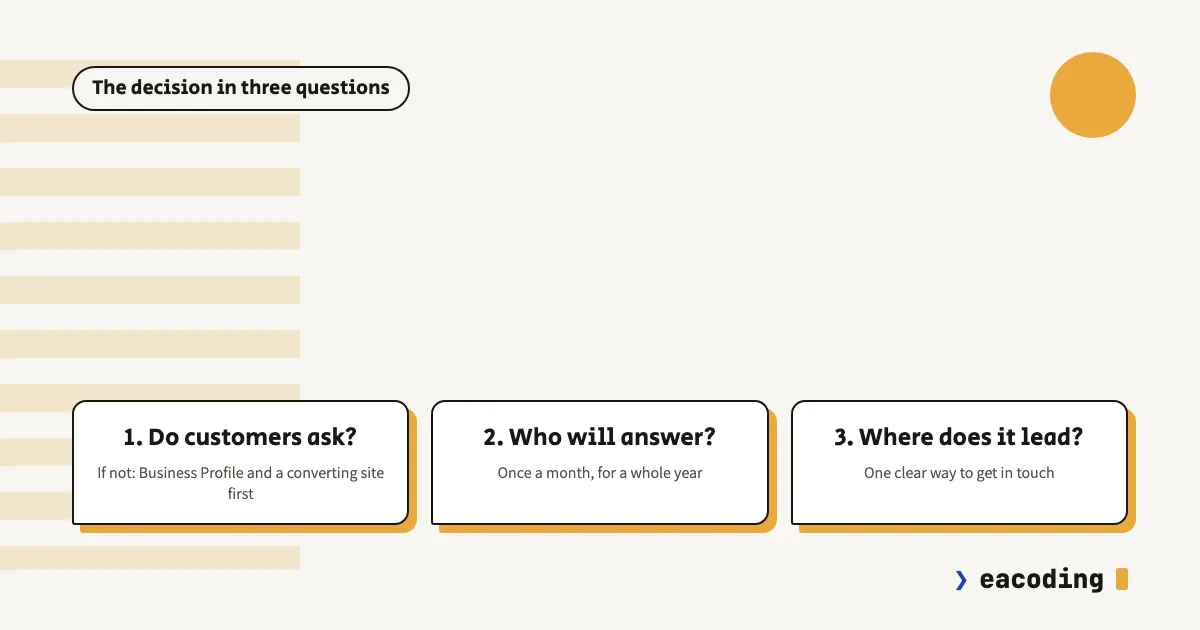
- Do your customers ask questions before they buy? If not, invest first in a Google Business Profile and a site that converts. If yes, continue.
- Who will answer, and at what pace can you keep it up for a whole year? "Me, once a month" or "I record, someone writes" are good answers. "We'll see" is not.
- Where does the answer lead? Every post needs to end with one clear way to get in touch. A blog without that is a newspaper, not a marketing tool.
Three yeses: write, and start with the question you're most tired of answering on the phone. Fewer than that: you have a clear list of what to fix first.
Bottom Line
A blog for a small business isn't "mandatory for SEO" and isn't a trend. It's a way to answer once, well, the questions you answer again and again, so that Google, the chatbots and the next customer find your answer. When there are questions and someone to answer them, it's one working day a month that keeps working for years. When there aren't, save the money.
Want to check whether your site is even built for a blog that Google and AI assistants will read? Talk to me and we'll go through the list of questions worth answering together.
FAQ
Does a blog help a website rank on Google?
Yes, but not because of "fresh content" - because of questions. Your service pages rank for the name of the service; a post answers a question a customer asks before buying, like "how much does it cost" or "what's the difference", and those are searches a service page can't capture. The same answers are what AI assistants quote when they recommend a business.
How many posts does it take to see results?
Fewer than you think, and more time than you'd like. Ten to fifteen posts that genuinely answer your customers' common questions cover most of the need, and first results on Google usually arrive after three to six months. One good post a month beats four thin ones a week.
Can I write the blog with AI?
You can use it to help; you shouldn't let it write instead of you. A post generated automatically without real experience looks exactly like a thousand other posts, Google classifies mass production like that as spam, and customers recognise it. What brings customers is what only you know: what actually happens, what failed, what you recommend and why.
What's better for a small business, a blog or social media?
They aren't the same tool. A social post lives a day or two and disappears; a blog post that answers a question keeps bringing people for years. A business that lives on walk-in customers gains more from a Google Business Profile and social media; a business whose customers research before they call gains more from a blog.
More from the blog
Is an Accessibility Plugin Enough to Comply With Israeli Law?
A floating accessibility widget doesn't make a site comply with IS 5568. What the widget really does, where it fails, why it sometimes hurts, and what does cover you.
7 min readHow to Write a Website Accessibility Statement in Israel (With a Template)
The accessibility statement under Regulation 35: what the regulations require in it, where to put it, what never to write, and a template you can adapt to your site.
7 min readHow Do You Back Up a Website Properly? What, Where, and How Often
A backup that actually saves you: what must be in it (not just files), where never to store it, how often by site type - and how to know it works at all.
6 min read
Reaching me is the easy part.
A few lines in the form if you prefer writing - or straight to the channel you already use. Either way, it's me answering.