How Much Does a Website Cost in 2026? What Actually Sets the Price
It's always the first question, and fairly so - nobody starts a project without a sense of scale. So here's the honest answer: for the same "business website" you'll get quotes spanning a tenfold range, sometimes more. Not necessarily because someone is playing you, but because "a website" is one word covering entirely different products.
You won't find a price list here - nor on most serious developers' sites - and further down I'll explain why that's actually a good sign. What you will find: exactly what sets the price, so you can read quotes like someone who understands what's written in them.
The six things that move the price
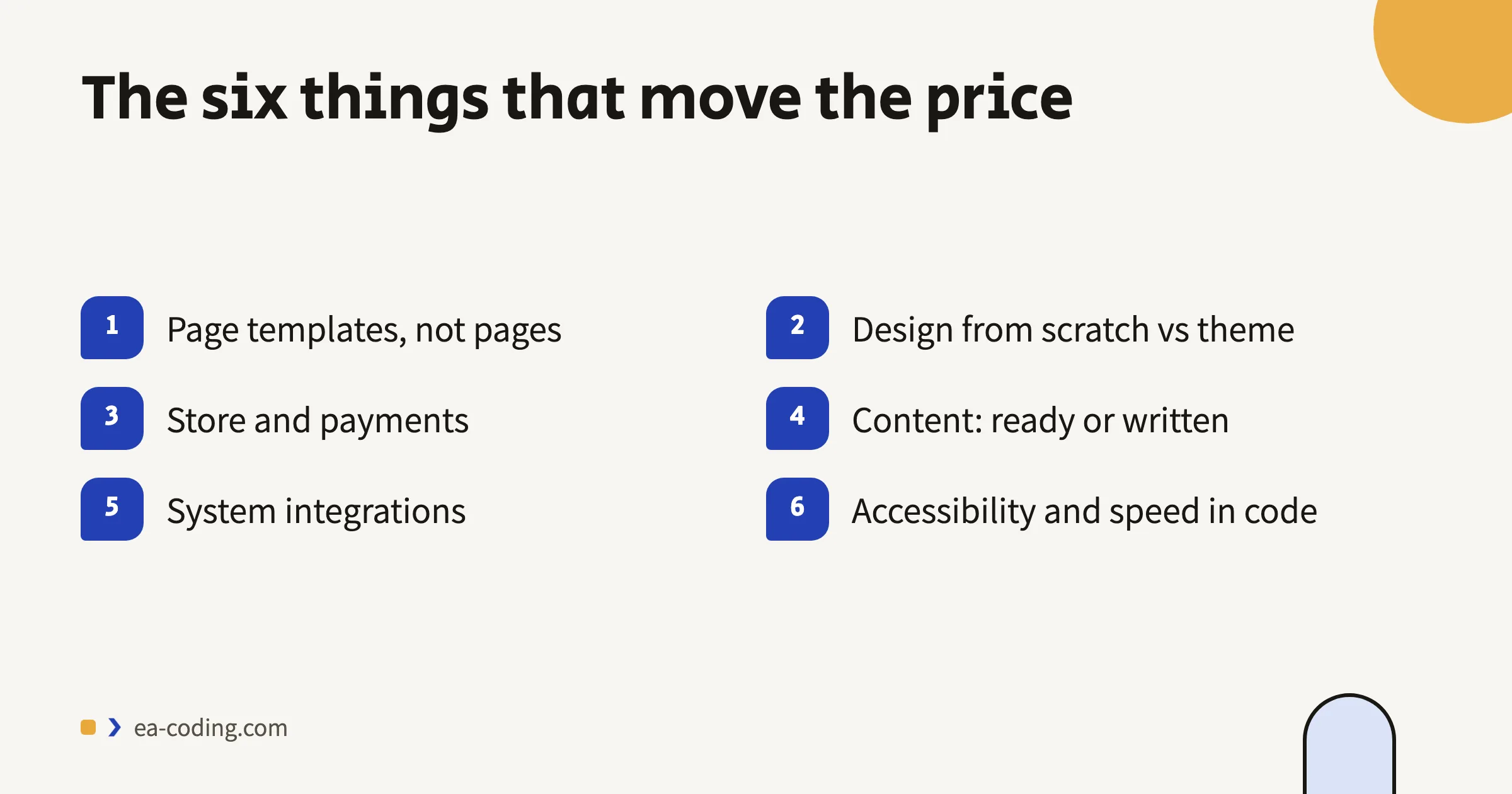
1. How many page types, not how many pages. A homepage, a service page, a contact page - each is a template that needs designing and building. But twenty service pages using the same template cost nearly the same as five. When someone asks "how many pages," the real question is how many distinct templates.
2. Custom design versus an existing theme. A ready-made theme adapted to your brand saves weeks of design work. Design from scratch around the business costs more - sometimes worth every shekel, sometimes unnecessary. This difference alone can double a quote.
3. A store and its systems. The moment payments, inventory, invoicing and shipping enter, it's no longer "a website with an extra page" - it's a different product. Every such integration means configuration, testing, and potential faults. I covered this in depth in the store guide.
4. Who writes the content. If the copy, photos and logo arrive from you ready to use - you've saved money. If a copywriter, photographer or designer is needed, that enters the price, at the developer's or a separate vendor's. Incidentally, it's also the number-one schedule killer.
5. Integrations with external systems. A CRM, a booking system, a newsletter, accounting software - every integration is real work, even when it looks like "just a button".
6. Accessibility, speed and standards. A site that meets IS 5568 in code, loads fast on mobile and is built for search takes work that a "just make it exist" site doesn't. The difference isn't visible in the demo; it shows a year later, in Google and in the demand letters that never arrived.
Why serious developers don't publish a price list
Because a price without discovery is a guess, and whoever guesses, guesses in their own favor. A real quote comes after a conversation that clarifies what you need: how many templates, what already exists, what gets connected. Someone quoting a number before asking a single question is either building in a safety margin you're paying for - or planning to discover "extras" later.
The first number thrown out in a conversation isn't the price. It's an opening move - or a warning sign.
How much does a WordPress website cost?
The most common question, so a straight answer without numbers (why without - previous section): a WordPress site on a quality theme adapted to your brand is usually the most economical route to a full business website, because much of the work already exists. The price climbs with everything that moves away from the shelf: design from scratch, multiple content templates, system integrations and paid plugins. And don't forget the running cost - licences, hosting and monthly maintenance - which on WordPress is a real part of the picture.
How much does an online store cost?
A store is always more expensive than a comparable brochure site, and not because of the design: payments, invoicing, shipping and inventory are systems that need connecting, configuring and testing. The gap between a "simple" store and a complex one is set mostly by catalogue size and integrations, and the platform choice changes the cost structure - subscription and fees versus build and maintenance - as detailed in the full comparison.
The too-cheap quote, up close
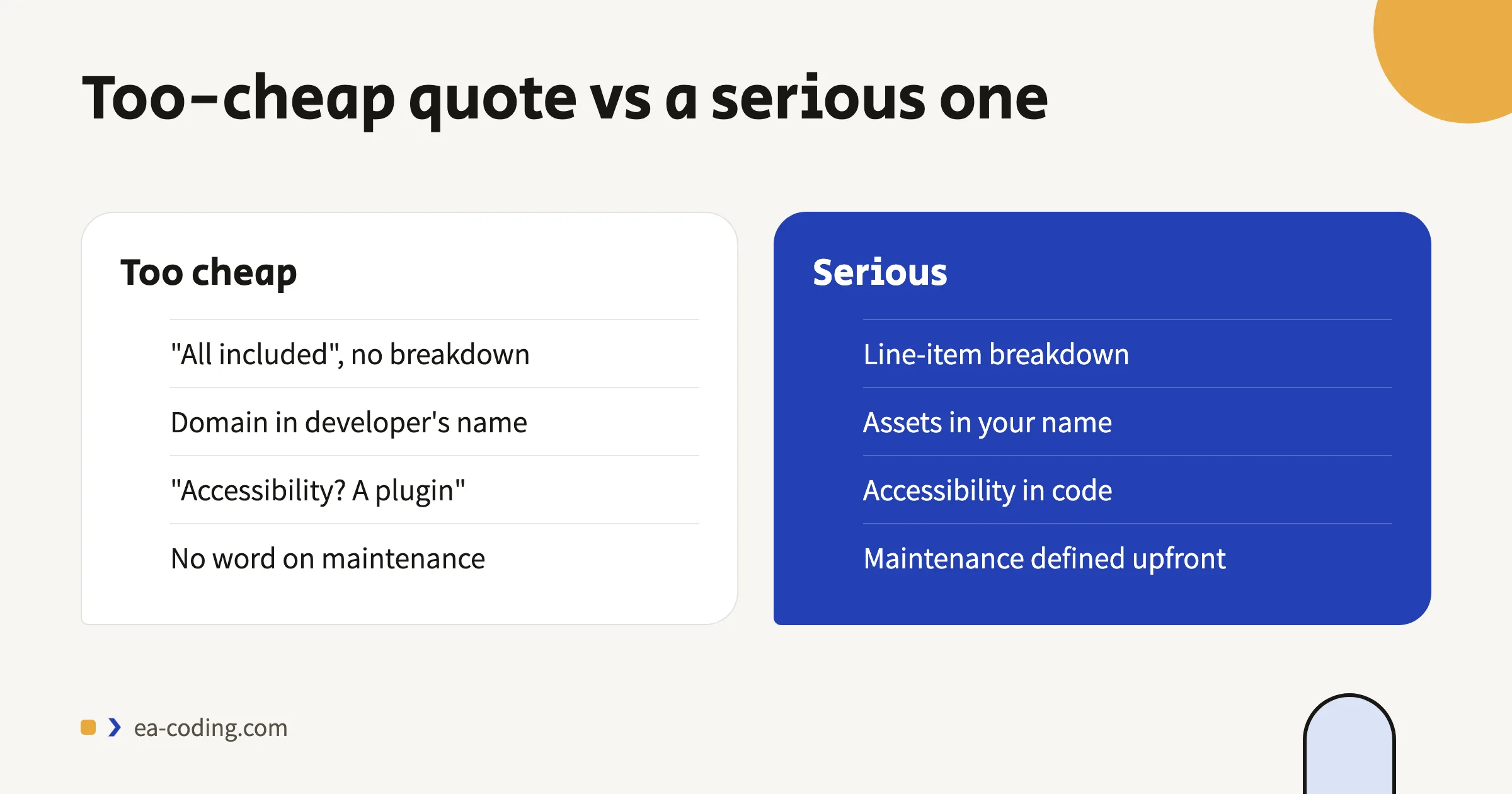
Some cheap quotes are legitimate - a ready theme, a small scope, a developer early in their career. And some are quotes whose cheapness surfaces later:
- "Everything included" with no scope document. When what's included isn't written down, everything you ask for becomes an "extra".
- The domain and hosting registered to the developer. That's what lock-in looks like. Check whose name is on the assets before signing.
- "Accessibility? We'll install a plugin." An overlay widget doesn't meet the standard, and the legal exposure stays yours.
- Not a word about maintenance. A website isn't a shelf product; what happens after launch is worth asking before launch.
- Speed not mentioned at all. A slow site quietly burns your ad budget. Test a site the developer built with Google's tool - it takes a minute.
How to compare quotes properly
- Demand a line-item breakdown. Design, development, content, integrations, accessibility, maintenance. A one-line quote can't be compared.
- Make sure everyone is pricing the same thing. If one quote includes copywriting and another doesn't, you're not comparing prices - you're comparing apples to nails.
- Ask what happens when you want a change. The hourly rate after launch reveals a lot about your shared future.
- Ask to see a two-year-old site. Not the polished launch - what's left of it. I keep a full list of questions to ask a developer before signing.
The real price isn't what you paid on launch day
A cheap site that brings no enquiries is the most expensive kind there is. A site built right - fast, accessible, findable on Google - returns the difference in leads, usually faster than you'd think. That calculation is worth running over three years, not over the first invoice.
Bottom line
"How much does a website cost" is the right question with a conditional answer: it depends on how many templates, who designs, what's connected, who writes, and to what standard. Anyone answering it with a number before understanding your needs answered a different question.
Want a real number instead of a guess? Tell me what you're building - a short discovery call, then a proper quote with a full breakdown. No surprises later.
More from the blog
Is an Accessibility Plugin Enough to Comply With Israeli Law?
A floating accessibility widget doesn't make a site comply with IS 5568. What the widget really does, where it fails, why it sometimes hurts, and what does cover you.
7 min readHow to Write a Website Accessibility Statement in Israel (With a Template)
The accessibility statement under Regulation 35: what the regulations require in it, where to put it, what never to write, and a template you can adapt to your site.
7 min readHow Do You Back Up a Website Properly? What, Where, and How Often
A backup that actually saves you: what must be in it (not just files), where never to store it, how often by site type - and how to know it works at all.
6 min read
Reaching me is the easy part.
A few lines in the form if you prefer writing - or straight to the channel you already use. Either way, it's me answering.