Business With a Physical Address? Your Google Profile Matters More Than Your Site
Before talking about the website at all, it's worth stopping on one question: when someone searches Google for "Italian restaurant in Herzliya", what do they actually see?
The answer isn't websites. The answer is a map with three pins, opening hours, a star rating and a directions button. The website, at best, appears below that. Which means that for a business with a physical address, the most important digital asset isn't the site - it's the Google Business Profile, and it's free.
That doesn't mean the site is unimportant. It means the order matters, and most people get it backwards.
Why It Works This Way
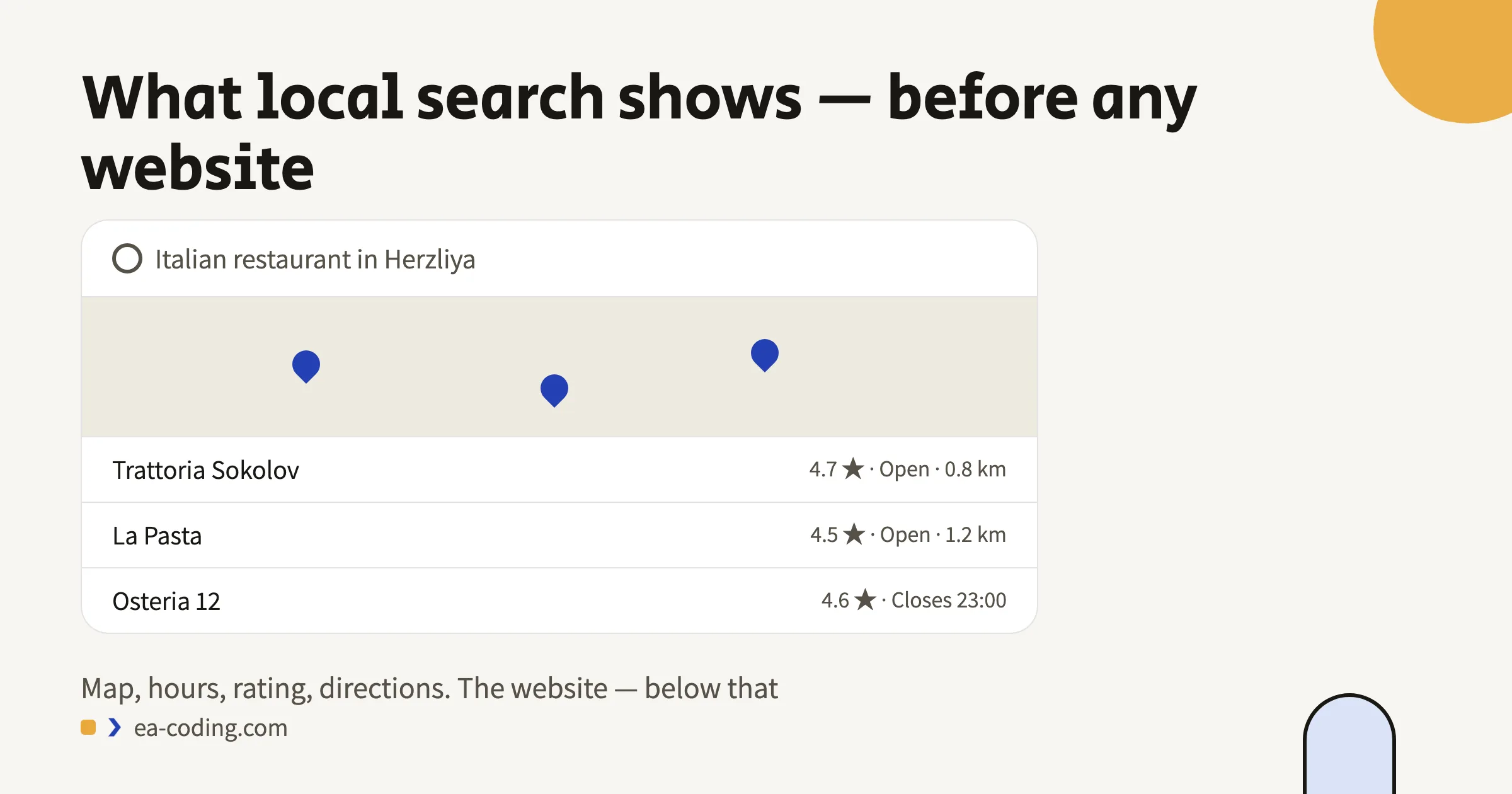
A search with local intent - "near me", "in Tel Aviv", "open now" - is a search where Google assumes you want to get somewhere, not read about it. So it shows what answers that: who's close, who's open, who's well rated, and how to get there.
The practical consequence: you can do excellent work on the website and not move a millimetre on those searches, simply because the game is being played on a different field.
What Actually Moves the Needle
There's no published formula, but there are things that recur in every business that improves:
1. A complete profile, not half of one. An accurate primary category (a common mistake - "restaurant" instead of "Italian restaurant"), correct hours including holidays, phone, website, description, and a service area if relevant. An incomplete profile is one Google trusts less.
2. Real photos, added regularly. Not three pictures from 2019. The inside, the outside (so people recognise it from the street), the team, the product. Businesses that post photos consistently look active - to Google and to a person choosing between two options.
3. Reviews, and replies to reviews. This is the factor most businesses neglect and the one that most affects the actual decision. Ask a happy customer for a review in the moment, not a fortnight later. And reply - to the good and the bad. A measured reply to a negative review makes a better impression than ten glowing ones.
4. Consistent details. The same name, address and phone - on the profile, the site, Facebook, directory listings. When the details disagree, Google has to guess which is right, and that isn't in your favour.
5. Updates and posts. An offer, special holiday hours, a new product. It's content and a sign of life at once.
A Google Business Profile isn't "another channel". For a business with a door that opens, it's the first shop window - and unlike the website, it costs nothing.
No Shopfront? Businesses That Go to the Customer
An electrician, movers, cleaners, a personal trainer - businesses that come to the customer rather than the other way round. The profile matters to them too, arguably more, because they have no other shop window. The difference: set the profile up as a service-area business.
- Hide the address. If there's no place customers come to, your home address shouldn't appear on the map - and it's better that it doesn't. Google lets you hide it and show a service area instead.
- Set a real service area. The towns and areas you actually travel to - not "the whole country" to look big. An unrealistic area hurts ranking in the local searches that actually matter to you.
- Reviews work exactly the same way. A customer served at home can leave a review just like one in a shop. Asking at the end of the job matters even more, because there's no "before you leave" moment.
- The site needs to say it explicitly. "We serve Tel Aviv, Ramat Gan, Givatayim and Bnei Brak" in text, not only in the profile. That's what Google reads to connect the search with the site.
What Not to Do
No fake reviews. They get detected, and they damage the profile in ways that are hard to undo.
Don't stuff keywords into the business name. "Home Pizza - Best Pizza in Tel Aviv, Delivery" is not a business name. It's against Google's guidelines and it can get your profile suspended.
No fake address to appear close to a desirable area.
And What the Site Should Do
This is where the website comes in - not as a competitor to the profile, but as its reinforcement:
- A page per branch. A chain with four branches needs four pages, each with its address, phone, hours and a map. One "Branches" page with a list is a wasted opportunity.
- Exactly the same details as the profile. If the phone number on the site differs, you fixed something in one place and forgot the other.
- Structured data (Schema). Local business markup helps Google read the address, hours and rating with confidence. Not magic, but it removes guesswork.
- Speed on mobile. All this traffic arrives from a phone, on the way somewhere. A site that loads slowly at exactly that moment loses the customer to a competitor who already opened Waze. I went into what slows sites down in the PageSpeed guide.
- Don't block Google. If the site isn't indexed at all, the profile loses an anchor. How to check that is here.
The Order I Recommend
- Complete the Business Profile fully. A week of scattered work, zero budget.
- Build a habit of asking for reviews. Even one sentence at the end of a service.
- Make sure the site agrees with the profile on every detail.
- Only then talk about ad budgets.
That order saves a lot of money, because it fixes what's free before buying traffic.
A 2026 Bonus: Your Profile Feeds the Chatbots Too
When someone asks an AI assistant "who's recommended for X around Y", the recommendation is built largely from exactly the same sources: the business profile, the reviews, and how consistent your business name is across the web. Every hour you invested in the profile per this guide now works two channels at once - Google's map and the AI's answers.
Two points that matter more than ever in this era: detailed reviews (a sentence describing what you did is a ready-made quote for a chatbot) and an identical business name on every platform. How to get into the assistants' answers - in the full guide.
The Bottom Line
For a business with an address, local search isn't a niche - it's most of the intent. A complete profile, real reviews and a site that agrees with it will bring you more phone calls than any design change to your homepage.
Got one branch or ten and you're not sure the site supports them properly? Send me the URL - I'll check what the profile says, what the site says, and where the two disagree.
More from the blog
Is an Accessibility Plugin Enough to Comply With Israeli Law?
A floating accessibility widget doesn't make a site comply with IS 5568. What the widget really does, where it fails, why it sometimes hurts, and what does cover you.
7 min readHow to Write a Website Accessibility Statement in Israel (With a Template)
The accessibility statement under Regulation 35: what the regulations require in it, where to put it, what never to write, and a template you can adapt to your site.
7 min readHow Do You Back Up a Website Properly? What, Where, and How Often
A backup that actually saves you: what must be in it (not just files), where never to store it, how often by site type - and how to know it works at all.
6 min read
Reaching me is the easy part.
A few lines in the form if you prefer writing - or straight to the channel you already use. Either way, it's me answering.