How Do You Get ChatGPT to Recommend Your Business? What Actually Works
A few days ago a new enquiry came in. When I asked "how did you find me?", the answer was one I hadn't heard before: "We asked ChatGPT who builds accessible websites, and it recommended you."
This is no longer a future scenario. Some of your customers are done scrolling search results - they ask an AI assistant "who's recommended for X in Y" and get three names back. Either you're one of them, or you're not. So let's break down, without magic and without buzz, how you get into those answers.
How a Chatbot Picks Who to Recommend
It's worth understanding what happens behind the scenes, because it explains every recommendation that follows. When someone asks an AI assistant a local business question, two things usually happen:
It searches in real time. The major assistants no longer answer from memory alone - they run a web search, read a handful of results, and assemble an answer with sources. Meaning: whoever sits in the good search results is the raw material of the answer.
It leans on what's written, not what's implied. A search engine ranks pages; a language model reads them. A page that explicitly says "I build accessible websites to IS 5568, based in Tel Aviv" hands the model a ready-made sentence to quote. A page that says "advanced digital solutions" gives it nothing to work with.
The central conclusion is already here: there is no separate magic channel for AI. There's one web, and the assistants read it - just more literally than ever.
The Foundation Hasn't Changed: What Works on Google Works Here
Before any "innovative" trick, three plain facts:
- A site that isn't indexed on Google doesn't exist for the AI either. Same pipes, same problem. If you're not sure you're even in the index - start with this check.
- A local business lives or dies on its Google Business Profile. Assistants draw local recommendations from the same sources the map uses: a complete profile, real reviews, the right category. The full guide is here.
- Content that answers questions is the currency. That lead I mentioned above? The AI didn't invent me. It read articles I wrote about exactly the questions the customer asked.
What They Read on Your Site: Five Signals
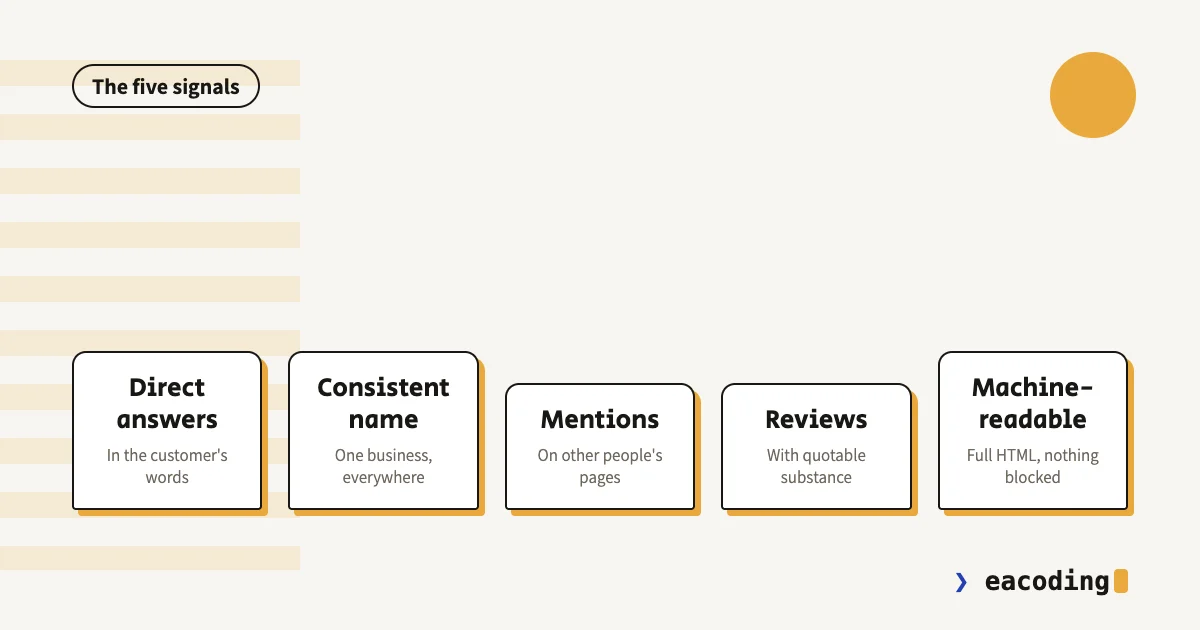
1. Direct Answers, in the Customer's Words
An AI assistant assembles its answer from sentences it finds. A page or article that opens with a clear answer - "How much does X cost? It depends on three things:" - is a natural candidate for quoting. Write about the questions you hear on the phone, in the language people ask them, and put the answer first rather than after eight warm-up paragraphs. The full formula for such an answer passage - in the position-zero guide.
2. One Business Name, One Story, Everywhere
A language model builds an "entity" out of your business: name, field, location. If your site says "Studio X", your Google profile says "X Digital" and Facebook says "X.co.il" - you've split yourself into three weak businesses. Identical name, consistent description and the same contact details everywhere you appear.
3. Mentions on Other People's Pages
Assistants also quote articles, guides and "recommended" lists. A mention in an industry piece, a podcast interview, a line in someone else's guide - all of it builds the model's confidence that you're real and relevant. It's this era's version of links, except now the text around them gets read too.
4. Reviews with Substance
"Professional, recommended!" is nice for the ego. A review that says "built our WordPress store, hit the deadlines, the site passes accessibility checks" is a paragraph the AI can quote when someone asks about exactly that. Don't ask clients for "a review" - ask them to write what you did for them.
5. A Site a Machine Can Read
Two technical things worth checking once: that your content exists in the HTML rather than being drawn only after scripts run (known as server-side rendering - most sites are fine, sophisticated setups sometimes aren't), and that your robots.txt isn't blocking the AI assistants' crawlers. Some site owners blocked them deliberately two years ago and forgot - a legitimate decision, just make sure it's still your decision.
What Doesn't Work, and Costs Money Anyway
Promises like "we'll push you into ChatGPT" are the same old tricks under new names. There is no "add me to the AI" button. Keyword stuffing doesn't work on a model that understands language. Fake reviews are a risk with Google and with the customer who finds out. And anyone guaranteeing results in a field nobody fully controls is telling you everything you need to know about them.
The less glamorous truth: the road into AI answers runs through doing good work and writing about it clearly. There's no shortcut.
What to Do This Week
- Ask, yourself. Open two or three AI assistants and ask "who's recommended for your field in city" and "is business name recommended?". The answers tell you exactly where you stand and what the model knows about you.
- Verify the foundation. Indexed on Google, a complete business profile, a consistent name across platforms.
- Write one good answer. Take the question you hear most on the phone and write a page that answers it straight. One a month is plenty.
- Ask for a detailed review from your last two happy clients.
- Check robots.txt - or ask whoever built the site to confirm AI crawlers aren't blocked by accident.
How You Know It's Working
Honesty required here: there's no tidy report yet showing "you appeared in X chatbot answers". The main measurement tools are simpler - ask the assistants yourself every few weeks, and ask every new lead "how did you find me?". That old question matters again: it's the only way to know this new channel has started working for you.
And if your next lead answers "ChatGPT recommended you" - remember the moment. Mine already happened.
Bottom Line
AI assistant recommendations aren't magic and aren't a new marketing channel to "crack" - they're a reflection of your existing presence on the web, seen through eyes that read everything literally. The foundation is what always worked: be clear, be consistent, answer real questions, and let happy clients tell the story.
Want to know how your site reads to a machine - and what's missing before they'd recommend you? Talk to me - we'll go over it together in a short call.
More from the blog
Is an Accessibility Plugin Enough to Comply With Israeli Law?
A floating accessibility widget doesn't make a site comply with IS 5568. What the widget really does, where it fails, why it sometimes hurts, and what does cover you.
7 min readHow to Write a Website Accessibility Statement in Israel (With a Template)
The accessibility statement under Regulation 35: what the regulations require in it, where to put it, what never to write, and a template you can adapt to your site.
7 min readHow Do You Back Up a Website Properly? What, Where, and How Often
A backup that actually saves you: what must be in it (not just files), where never to store it, how often by site type - and how to know it works at all.
6 min read
Reaching me is the easy part.
A few lines in the form if you prefer writing - or straight to the channel you already use. Either way, it's me answering.