WordPress or a Custom Website? An Honest Guide from Someone Who Builds Both
Two sentences keep coming up: "I was told WordPress isn't serious", or "I was told a coded site will cost me a fortune." Whoever told you that most likely builds only one of the two - and is selling you the thing they know how to build.
I build both WordPress sites and custom websites in Vue and Nuxt, and I've been doing it for over five years. I have no horse in this race. So here's the guide I wish someone handed you before you sign a quote.
The Wrong Question
"Which is better, WordPress or custom code?" is like asking "which is better, a truck or a motorcycle?" Depends what you're hauling, where to, and how many times a day.
The right question is: what does this website need to do, and who is going to run it day to day? Answer that honestly, and the decision almost makes itself.
When WordPress Is the Right Choice
WordPress was built to manage content, and it still excels at exactly that. If you recognize yourselves in any of these, that's probably your direction:
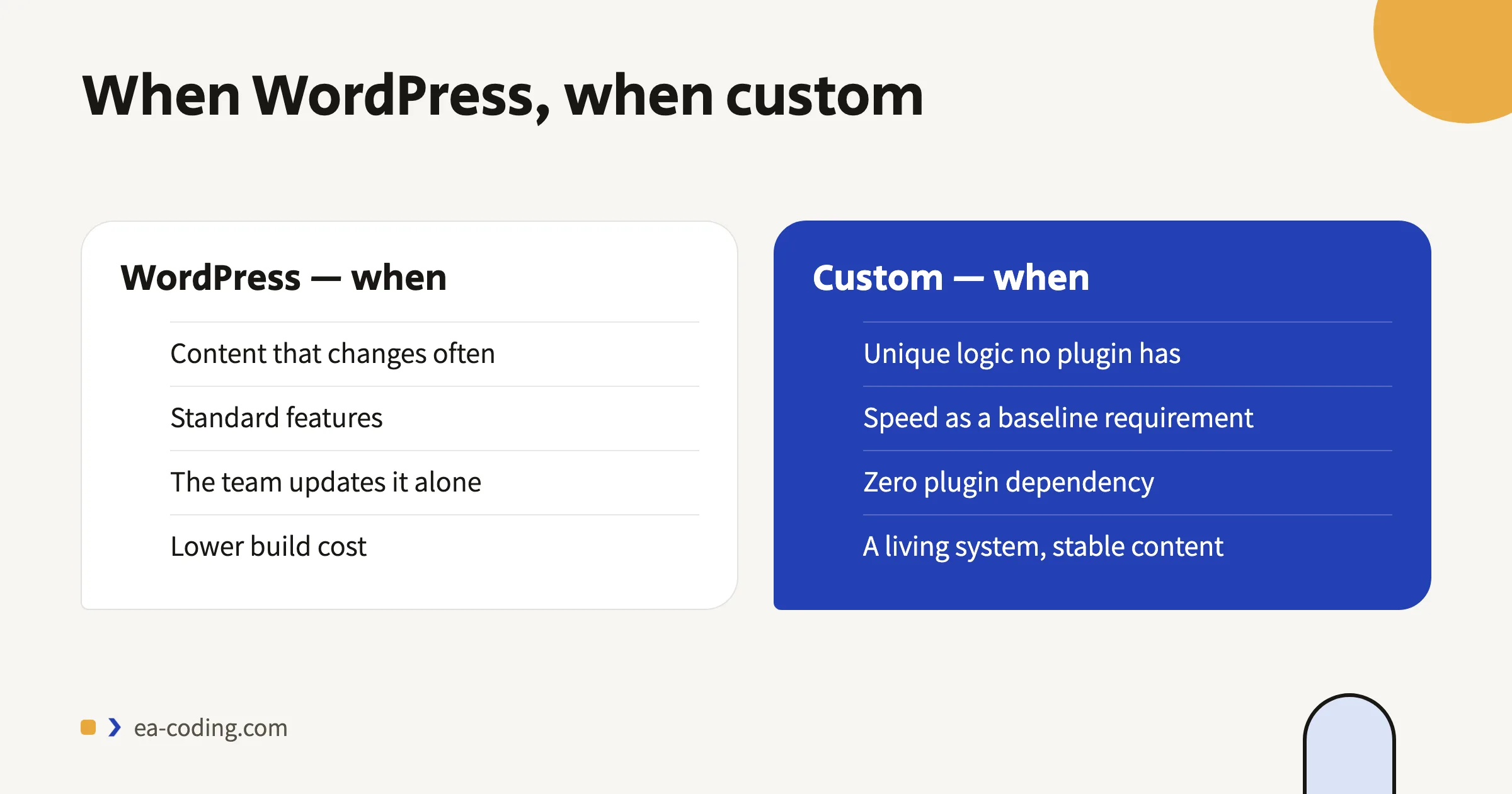
- You publish content regularly. A blog, articles, guides, updates - a site that lives on content needs a mature content management system.
- You want to edit things yourselves, without waiting for anyone. Swap an image, update a price, add a page - no email to a developer, no invoice.
- Your needs are standard. Service pages, about, contact, gallery. WordPress solves these fast, well, and at a sane cost.
- You want any developer to be able to pick up where the last one left off. The ecosystem is enormous, and you're not locked in to a single vendor.
A WordPress site built properly - a lean theme, no pile of unnecessary plugins, solid hosting - is an excellent working tool. I go deeper into how I build them on my WordPress services page.
When a Custom Website Pays Off
Custom code enters the picture when the site isn't just "a business card with pages" but a product in its own right:
- You have a unique product or system. A custom calculator, a members' area, an integration with an internal system, business logic no off-the-shelf plugin covers. Bending WordPress into that shape is building a house on a tent's foundations.
- Speed is business-critical. When every tenth of a second of load time is worth money, a static or Nuxt-based site delivers performance that's very hard to match with a heavy, generic system.
- You want a user experience nobody else has. Animations, interactions, a design that doesn't compromise around a template's limits.
- The site needs to grow with the product. When the website is part of the system rather than a digital brochure, clean, well-structured code is an asset that appreciates over time.
The honest downside: day-to-day editing requires me (or another developer), unless you add a headless CMS - which is a project with a budget to match. More on my approach on the custom website development page.
What About an Online Store?
A store is its own discussion, because there the platform dictates your daily operational routine. In short: WooCommerce (on WordPress) gives you full control and ownership of everything, and shines with complex catalogs or special requirements - but maintenance is on you. Shopify takes the operational headache off your plate in exchange for subscription fees and commissions, and shines for people who want to sell, not maintain. The decision hinges on your catalog, your business model, and who runs the store - I've laid out the considerations on the e-commerce page.
And in Israel there's a further layer that decides more than any feature list: the payment provider, the invoicing system, the courier, and a theme that genuinely works in right-to-left Hebrew. The rule I work by: pick the payment provider first, confirm explicitly what it supports, and only then choose a platform. I took that whole decision apart in the Shopify vs WooCommerce guide for Israeli stores.
The Honest Comparison Table
| Criterion | WordPress | Custom |
|---|---|---|
| Setup cost | Low to medium | Medium to high |
| Ongoing cost | Hosting, licenses, regular maintenance | Relatively low, mostly hosting |
| Editing independence | Full - that's the whole point | Limited, unless a CMS is integrated |
| Speed | Good when built right, takes effort | Excellent by default |
| Flexibility | High, within the ecosystem's limits | Practically unlimited |
| Maintenance | Ongoing updates, non-negotiable | Minimal after launch |
The right platform isn't the one that sounds most impressive in a meeting - it's the one that won't get in your way a year from now.
Hold On - What About Wix, Squarespace and the AI Builders?
This comes up in almost every conversation, and fairly so: these are real tools you can get a site live with over a weekend. So, honestly, when are they the right call and when aren't they.
They suit a site that's a business card. A small business needing a presence, a few pages, a form and a phone number - with nobody to maintain it. That's an entirely legitimate use, and I say so to my own clients when it's true.
And the AI site builders? The new generation produces a whole site from a few sentences about the business, and it's genuinely impressive. But it changes the starting point, not the answer: the AI assembles variations of the same site for everyone, and the moment it's live you're on exactly the same field - same limits, same platform dependence.
They suit less well when the site has to work. The moment you need a connection to an existing system, a repeating content structure with many items, full control over speed, or deep Hebrew and RTL adjustments - that's where you start hitting walls you can't move.
Two things worth knowing up front, because they surprise people later:
Portability. A WordPress site can be packed up and moved to another host. A site on a closed builder can't, really. You can export content, but not the site; moving out is a rebuild. That's not disqualifying, it's simply a decision worth making on day one rather than in year three.
Accessibility. Builders are improving here, but their templates weren't built for the Israeli standard, and your control over the code is limited - which means your ability to fix what breaks is limited too. If you have to meet IS 5568, check this before choosing a platform, not after.
My rule is simple: a builder is a good choice when the site doesn't need to grow. If there's a fair chance it does, better to start with something you can take with you. I unpacked this whole dilemma in depth - including when DIY genuinely wins, the five walls you meet after six months and the cost nobody sees - in the DIY vs developer guide.
Two Myths That Deserve a Burial
"WordPress isn't professional." Nonsense. WordPress runs a sizable chunk of the internet, including news sites, universities, and major brands. What's unprofessional is a WordPress site with forty plugins, a generic theme nobody hardened, and zero maintenance. That's not a platform problem - that's a builder problem.
"Custom code is always too expensive." Also nonsense, just in the other direction. A landing page or brochure site in modern code can be a compact, fast project - and after launch there are almost no running costs and no security-update treadmill. Sometimes it's the WordPress site, with its plugin licenses and monthly maintenance, that ends up costing more over time. "Expensive" is measured over five years, not on the first invoice.
And You Can Combine Them
A little secret that someone selling only one platform won't tell you: it doesn't have to be either-or. One of my favorite combinations is WordPress as the content management system behind the scenes, with a custom Nuxt frontend out front. You get WordPress's editing freedom and the speed and design of custom code - in the same project. It doesn't fit every budget or every need, but when it fits, it's the best of both worlds rather than the compromise between them.
So How Do You Decide?
Ask yourselves three questions:
- How many times a month will we edit content ourselves? Often - big point for WordPress.
- Is there a requirement with no off-the-shelf solution? Yes - the point goes to custom.
- How much is each second of speed worth to us? If the answer is measured in leads and revenue - another point for custom.
And if the answers contradict each other? That's fine - they do in most real businesses. That's what a discovery call is for.
Not sure which side your website belongs on? Tell me what you need - and I'll tell you honestly what I would build, even if the answer is "not with me."
More from the blog
Is an Accessibility Plugin Enough to Comply With Israeli Law?
A floating accessibility widget doesn't make a site comply with IS 5568. What the widget really does, where it fails, why it sometimes hurts, and what does cover you.
7 min readHow to Write a Website Accessibility Statement in Israel (With a Template)
The accessibility statement under Regulation 35: what the regulations require in it, where to put it, what never to write, and a template you can adapt to your site.
7 min readHow Do You Back Up a Website Properly? What, Where, and How Often
A backup that actually saves you: what must be in it (not just files), where never to store it, how often by site type - and how to know it works at all.
6 min read
Reaching me is the easy part.
A few lines in the form if you prefer writing - or straight to the channel you already use. Either way, it's me answering.